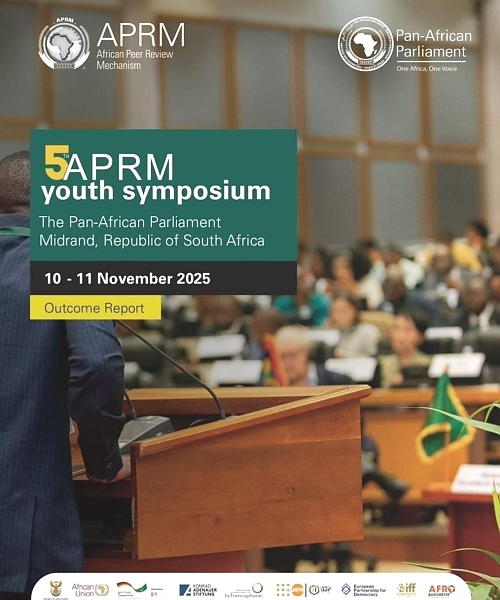
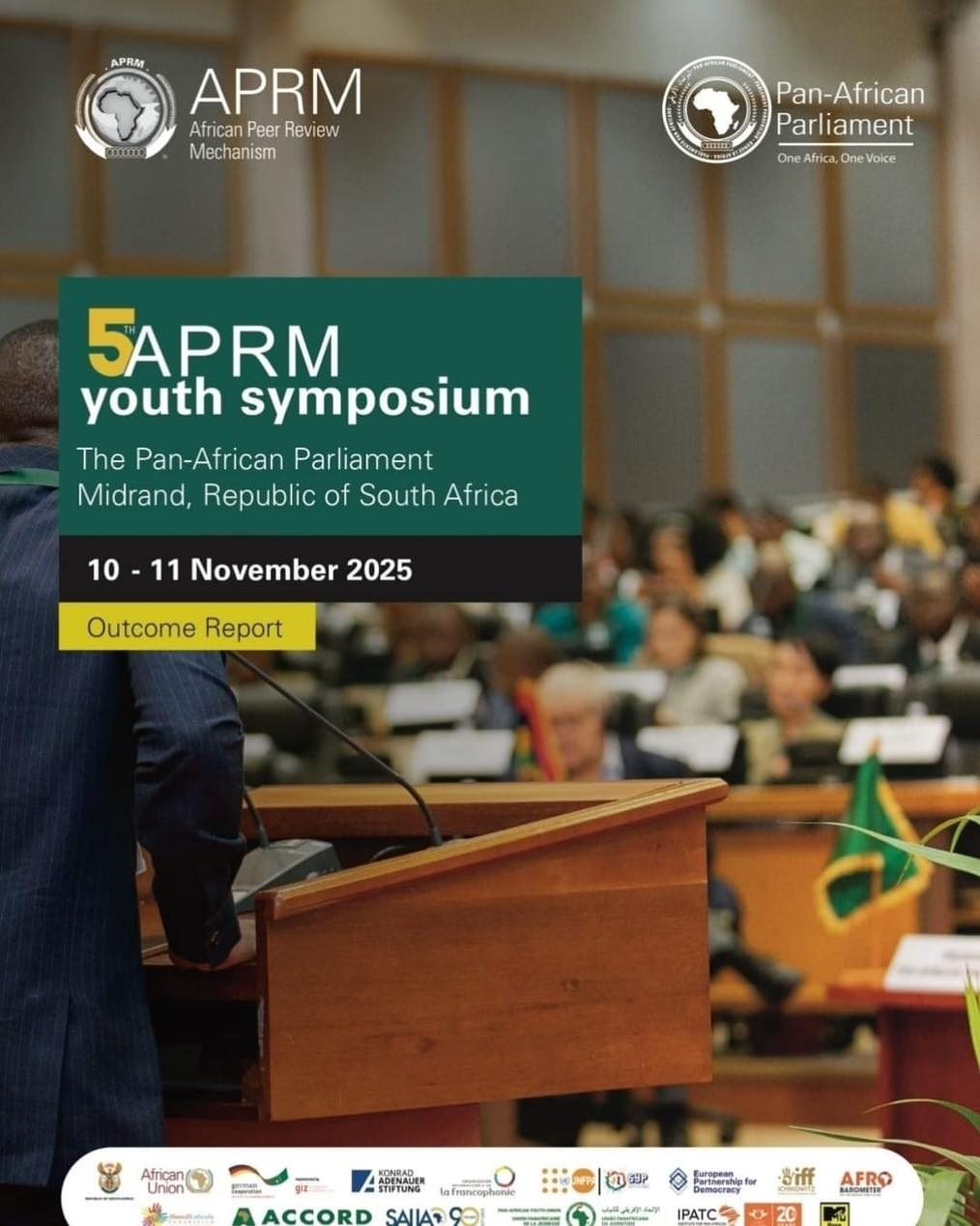
The 5th APRM Youth Symposium Outcome Report
The 5th APRM Youth Symposium was held from 10 to 11 November 2025 at the Pan-African Parliament in Midrand, Republic of South Africa, under the theme “Youth in Governance: From Promise to Prosperity”. It brought together more than 700 young participants, including 300 international delegates, and reached an online audience of more than 100,000 people through live digital platforms under the hashtag #APRMYouth.
Beyond the scale of participation, the Symposium served as a high-level policy and consultative platform. It contributed to the institutionalisation of youth engagement within the APRM, responded to the AU Assembly Decision Assembly/ AU/Dec.874(XXXVII), and generated inputs for the Africa Governance Report 2027. Its timing, ahead of the 20th Anniversary of the African Youth Charter in 2026, gave the discussions additional institutional weight. The proceedings showed that youth participation in Africa has entered a different phase.
The 5th APRM Youth Symposium supported by the Government of the Republic of South Africa and the Pan-African Parliament, with technical and financial contributions from GIZ, ACCORD, the Pan-African Youth Union, Konrad Adenauer- Stiftung, the Inclusive Society Institute, the South African Institute of International Affairs, the Institute of Pan-African Thought and Conversation, G20/Y20, Afrobarometer, Paramount Media/MTV, the Ahmed Kathrada Foundation, the Organisation Internationale de la Francophonie, the European Partnership for Democracy, the Ichikowitz Family Foundation and UNFPA.
Since its inception in 2017, the APRM Youth Symposium has grown into a continental platform for intergenerational dialogue, youth-led policy reflection and governance innovation. The 5th edition built on this foundation by placing stronger emphasis on influence, implementation and accountability, rather than on consultation alone.
This focus reflected the wider African context in which the Symposium took place. Youth-led civic mobilisation, rising demands for accountable institutions, continued unemployment, technological change and renewed concerns over unconstitutional changes of government all shaped the discussion. Against this background, youth in governance was treated as both timely and urgent.